

 English
 中文简体
 عربى
 Español



Automotive Driveline Guide: Components, Tolerances, Failure Points & Sourcing Checks
Posted by Admin | 23 Oct
Content
- 1 What an Automotive Driveline Includes
- 2 Component by Component: Function, Failure Trigger, Inspection Point
- 3 FWD, RWD and AWD: What Changes in the Part List
- 4 Tolerances and Material Details That Decide Fit and Life
- 5 Where Drivelines Fail First, and What It Tells You
- 6 Electrification Changes the Load Case, Not the Physics
- 7 Sourcing Checklist Before You Approve a Driveline Supplier
A front-wheel-drive car that shudders between 40 km/h and 70 km/h usually traces back to one of four parts: a worn outer CV joint, a boot that has thrown its grease, a bent half shaft, or a hub bearing that has lost preload. Diagnosis takes an hour. Fitting the wrong one of those four takes a second visit — which is the point where an automotive driveline stops being an engineering topic and becomes a purchasing decision.
The short answer: an automotive driveline is the mechanical chain that carries rotational power from the engine or electric motor output to the driven wheels, and it is judged on three things only — how accurately it fits, how smoothly it spins, and how long it lasts under load. Every dimension on a drawing, every material choice and every process control exists to support one of those three.
What follows is the working version of that idea: what the driveline includes on front-, rear- and all-wheel-drive layouts, which tolerances decide whether a part fits the first time, where these parts actually fail, and what to verify before approving a supplier for OEM, aftermarket or custom programs.
What an Automotive Driveline Includes
The two words get used interchangeably, so it helps to fix the boundaries. The drivetrain covers the engine or motor, the transmission or transaxle, and the clutch or torque converter. The driveline begins after that — everything transmitting torque from the transmission output to the road surface.
On a transverse front-wheel-drive car the chain is short: transaxle output, inner CV joint, half shaft, outer CV joint, hub bearing, wheel. A rear-wheel-drive car spreads the same job over a longer path: transmission, prop shaft with a joint at each end, differential, axle shafts, hubs. All-wheel drive inserts a power take-off unit at the front and a rear drive module at the back, which is why an AWD driveline has roughly twice the part count and twice as many places for a vibration to start.
If you need the component-level view, this breakdown of driveline components walks through the joints, shafts and bearings individually and explains how each one connects to the next.
Component by Component: Function, Failure Trigger, Inspection Point
The table below is the version used in supplier reviews. It links each driveline part to the load it carries, the condition that kills it first, and the measurement that tells you whether a used part is still serviceable.
| Component | Main function | What fails first | What to inspect |
|---|---|---|---|
| Inner CV joint (tripod type) | Carries torque while allowing axial plunge | Grease loss, roller wear, raceway pitting | Axial play, roller surface, grease condition |
| Outer CV joint (Rzeppa type) | Transmits torque through steering angles | Raceway pitting, boot split, knocking on full lock | Noise on turns, cage and ball condition |
| CV axle assembly / half shaft | Carries torque between joints, must stay balanced | Impact bend, corrosion, unbalanced weld | Straightness, runout, dynamic balance |
| CV boot | Keeps grease in, water and grit out | Ozone cracking, heat ageing, clamp creep | Hardness, low-temperature flex, clamp seal |
| Prop shaft | Moves torque over distance, absorbs length change | Joint play, imbalance, centre bearing wear | Joint play, runout, balance |
| Hub bearing | Supports vehicle weight and wheel rotation | Seal damage, water ingress, lost preload | End play, rotation noise, seal condition |
| Motor shaft (EV / NEV) | Feeds motor torque into reduction gearing | Spline wear, high-RPM imbalance | Spline fit, surface hardness, runout |
Across all of these, the CV axle assembly carries the widest combination of loads at once: torque, axial plunge, steering angle and rotational balance. A shaft that measures straight but is unbalanced by a few grams will still produce a steering wheel shake at highway speed.
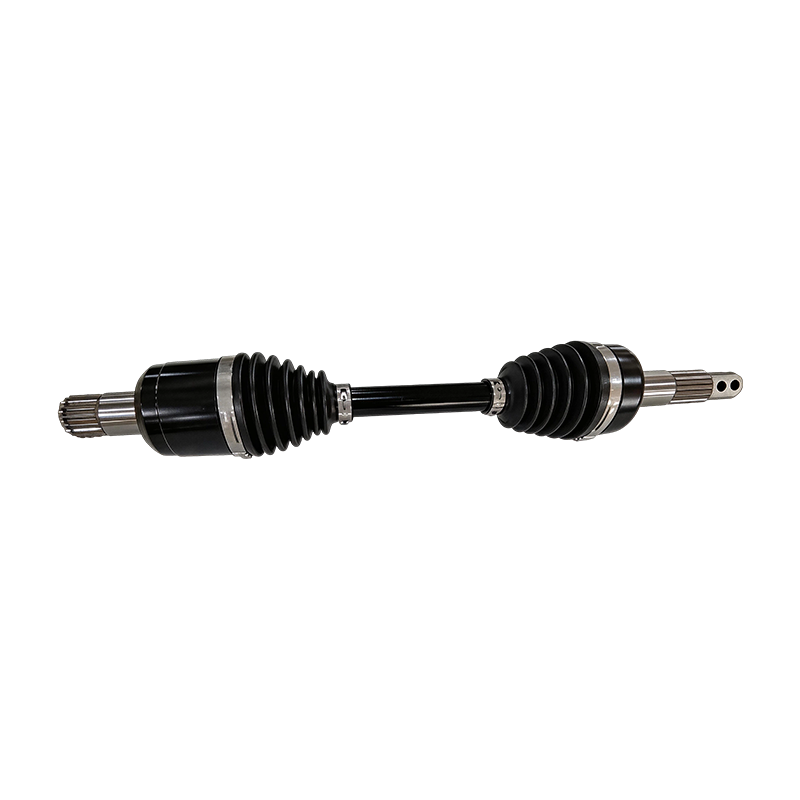 CV Axle Assembly and Drive ShaftPrecision-balanced CV axle assembly for driveline layouts where torque, plunge, steering angle and rotational balance combine; OE-style construction supports durability and compatibility.View Product →
FWD, RWD and AWD: What Changes in the Part List
Layout decides how many parts sit in the chain and which of them take the highest load. A component that is comfortably specified on one layout can be marginal on another.
Transverse front-wheel drive
- Two half shafts of unequal length, so the longer side needs a tuned damper or intermediate shaft to control torsional vibration.
- Inboard plunge joints absorb suspension travel; outboard joints handle steering angle.
- Steering rack boots and CV boots are the first rubber parts to age, and both are inexpensive to replace.
Longitudinal rear-wheel drive and 4WD
- A prop shaft running at higher speed makes balance and runout far more critical than on a short half shaft.
- A centre support bearing splits the shaft into two sections and introduces a second alignment point.
- Axle shafts at the rear are usually shorter and simpler, but they carry final-drive torque directly.
All-wheel drive and performance variants
- Extra joints mean extra tolerance stack-up; a 0.1 mm error at three interfaces becomes a visible vibration at the wheel.
- Torque split changes which shaft sees peak load, so both front and rear assemblies need the same durability validation.
Tolerances and Material Details That Decide Fit and Life
Most driveline comebacks are not caused by a part breaking. They are caused by a part sitting just outside the window the original design allowed. These are the points worth writing into a purchase specification:
- Spline fit. The fit between a shaft spline and the joint or hub is normally controlled on major diameter with a maximum permitted backlash. A spline that slides on by hand but rattles under torque reversal will be back in the workshop within a month.
- Axial plunge and angular range. Inboard joints must travel through the full suspension stroke without bottoming out; outboard joints must hold torque at full steering lock. Both limits should be stated, not assumed.
- Runout and dynamic balance. Total indicator readings for a passenger-car half shaft are commonly held in the region of a few hundredths of a millimetre, and balance is verified on a dedicated balancer rather than by feel.
- Boot compound. Chloroprene rubber keeps its flexibility at low temperature and resists ozone cracking; thermoplastic boots tolerate higher temperatures but need matching clamps and grease.
- Grease type and fill weight. Under-filling shortens joint life, over-filling can burst a boot. The fill weight belongs on the work instruction, not in the fitter's judgement.
- Clamps and sealing. Band clamps and wire clamps need different tools and different seating force; reusing a stretched clamp is the single most common cause of a repeat boot failure.
- Surface hardness of sliding surfaces. Raceways and splines need a defined hardness range and case depth, because a part that is too hard cracks and one that is too soft wears into play.
Where Drivelines Fail First, and What It Tells You
The cheapest part in the driveline usually decides the life of the most expensive one. A rubber boot ages, cracks at the fold, and starts throwing grease; once grease leaves, water and grit enter, the joint raceways pit, and vibration begins to work on the hub bearing and the mount. By the time a driver hears knocking on full lock, the joint is already beyond saving.
The practical consequence for workshops and distributors is simple: inspect boots at every service interval, replace them as a pair on the same shaft, and treat a boot kit as the cheapest insurance available in the entire driveline. A kit that includes the correct grease charge, both clamps and, where applicable, a new circlip closes the failure path completely.
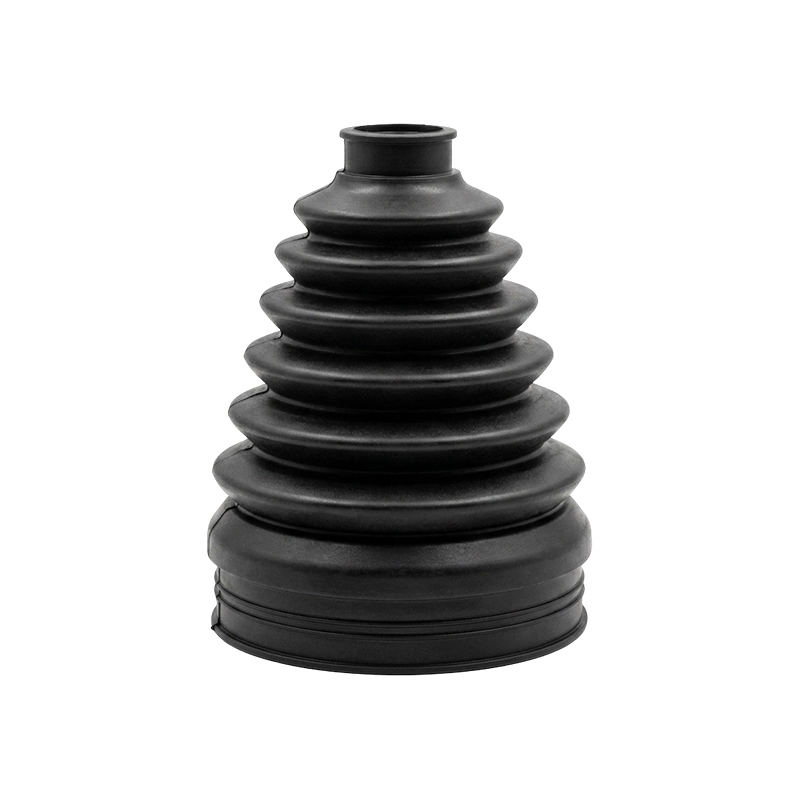 CV Joint Boot in CR MaterialChloroprene rubber boot protects CV joints from grease loss, ozone, weather and high-angle motion; suited to EV and combustion drivetrains.View Product →
Electrification Changes the Load Case, Not the Physics
Electric platforms remove the transmission tunnel and, on many designs, the prop shaft entirely — but they keep CV joints, half shafts, hub bearings and strut mounts. What changes is the duty cycle: motor speeds reach far beyond engine speeds, full torque is available from zero rpm, and regenerative braking reverses torque thousands of times per journey.
Noise is the other shift. Without an engine to mask it, a slight imbalance that would have been inaudible on a combustion car becomes the most noticeable sound in the cabin. Spline quality, rotor-side runout and balance limits therefore tighten rather than relax. The same logic applies to non-road applications: ATV, UTV and SSV axle shafts and light mobility parts such as scooter suspension mounts face impact loads that rarely appear on a passenger car.
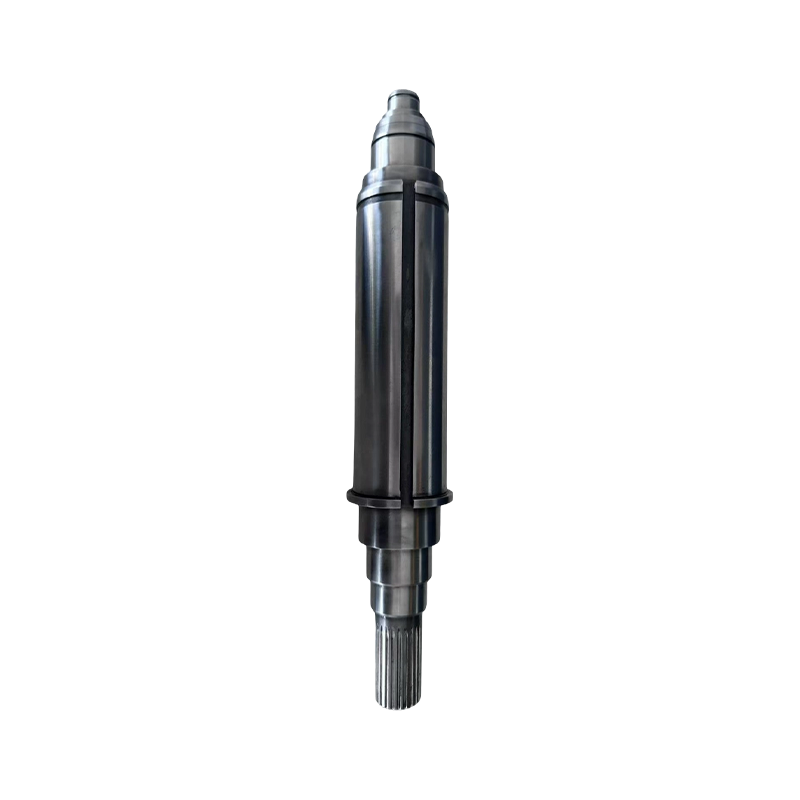 Precision EV/HEV Motor Shaft for Electric Drive UnitsPrecision-balanced EV/HEV motor shaft with hardened splines and journals, engineered for high-speed, high-torque electric drive units and NVH control.View Product →
Sourcing Checklist Before You Approve a Driveline Supplier
Purchasing decisions on driveline parts usually come down to five questions, and the answers should be documented rather than inferred.
- Process coverage. Can one partner produce the rubber boot, the machined joint and the heat-treated shaft under a single quality system? Splitting them across three vendors adds tolerance stack-up and breaks traceability. The driveline components range on this site is one example of that consolidated approach.
- Measured capability, not certificates alone. Ask for dimensional, runout and balance data from production batches, not only from the sample submission.
- Capacity and continuity. Annual output per process matters more than plant floor area when a program runs for five years.
- Program type. OEM supply is driven by validation and change control; aftermarket supply is driven by catalog coverage and packaging; custom projects are driven by drawing review and tooling lead time.
- Logistics. Port access and inland consolidation decide whether a promised delivery window survives a peak season.
| Program type | What matters most | Evidence to request | Common pitfall |
|---|---|---|---|
| OEM | Capability and long-term continuity | Batch dimensional data, runout and balance reports, change control records | Approving a supplier on certificates alone |
| Aftermarket | Coverage, packaging, minimum order | SKU-level fitment data, packaging specification, sample audit | One part number covering several vehicle variants |
| Custom | Joint development and tooling | Drawing review, sample lead time, tooling and validation plan | Leaving the boot compound or clamp type unspecified |
An automotive driveline rewards buyers who work backwards from failure. Fit, balance and durability are the only three tests that matter, and the parts that fail first are usually the cheapest ones — which is why a boot specification deserves as much attention as a shaft drawing. Agree the tolerances, ask for the measurements, and the difference between a first-time fit and a comeback stops being luck.
MAIL US
CONTACT US
+86 133 0665 0391
MAIL US
No. 169 Songpu Road, Cidong Industrial Zone, Cixi City, Ningbo City, Zhejiang Province, China
 OEM/ODM Automotive Chassis Sealing Components Manufacturer
EV Drivetrain Components Supplier