Content
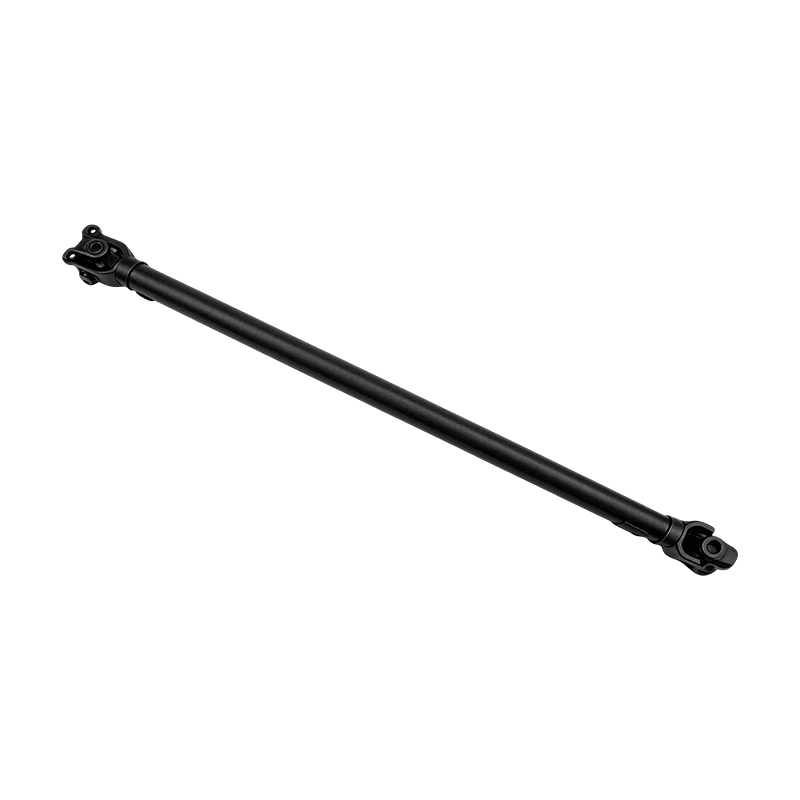
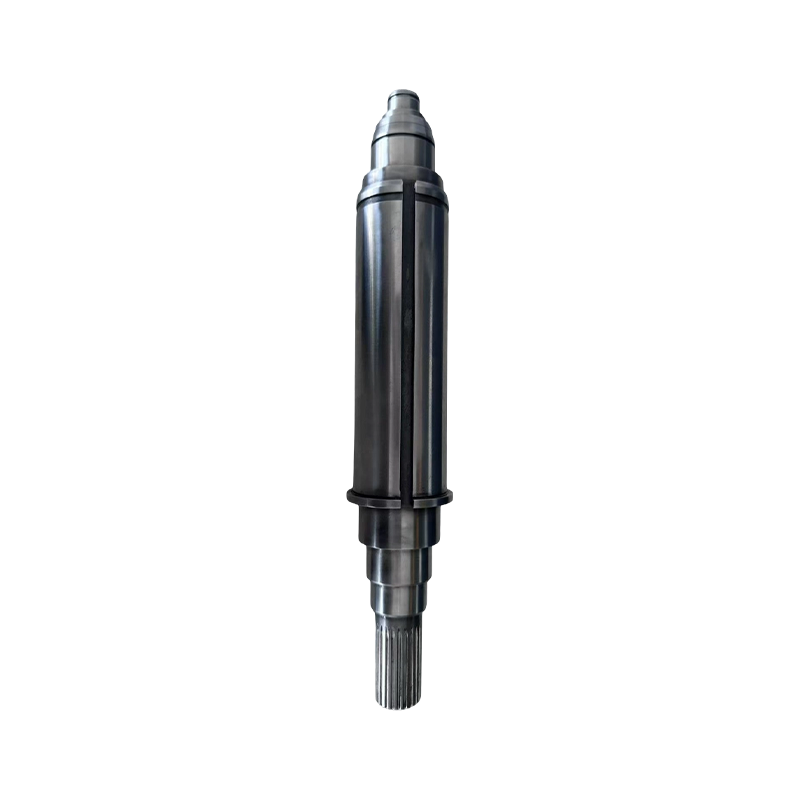
A drive shaft (also spelled driveshaft) is the rotating steel tube that transmits torque from the transmission or transfer case to the differential and, ultimately, to the wheels. Every drive shaft assembly consists of six fundamental parts: the shaft tube, universal joints (U-joints), slip yoke, flange yoke, center support bearing, and CV joints (on certain applications). Understanding each component helps you diagnose failures faster, source the right replacement, and maintain your vehicle's drivetrain before a small vibration becomes a roadside breakdown.
The shaft tube is the hollow cylindrical body that runs the length of the driveshaft. Most passenger-vehicle and light-truck tubes are made from cold-rolled DOM (Drawn Over Mandrel) steel, which delivers consistent wall thickness and excellent balance. High-performance and weight-sensitive applications increasingly use 6061-T6 aluminum or carbon-fiber composite tubes, which can weigh 40–60% less than comparable steel tubes while maintaining torsional rigidity.
Tube diameter and wall thickness are chosen to match the torque load. A standard half-ton pickup typically runs a 3.5-inch diameter steel tube, while heavy-duty trucks may step up to 4.0 or 5.0 inches. Carbon-fiber tubes used in performance applications often achieve the same strength at 3.5 inches with dramatically reduced rotating mass, lowering parasitic drivetrain loss.
Universal joints allow the driveshaft to transmit power through constantly changing angles as the suspension cycles. A U-joint consists of a cross-shaped trunnion (the "spider"), four bearing cups filled with needle rollers, and the yoke ears that clamp the assembly together. Standard OEM U-joints are rated for operating angles between 1° and 7°; exceeding 3° continuously accelerates wear and introduces a second-order vibration frequency.
U-joints are categorized by series number, which defines the cross size and torque capacity. The table below shows common U-joint series and their typical load ratings:
| Series | Cross Width (in) | Typical Application | Max Continuous Torque (lb-ft) |
|---|---|---|---|
| 1310 | 3.219 | Half-ton trucks, SUVs | ~1,350 |
| 1350 | 3.625 | 3/4-ton trucks, performance builds | ~1,700 |
| 1410 | 3.625 (heavy) | 1-ton trucks, heavy-duty | ~2,200 |
| 1480 | 4.188 | Commercial vehicles, high-torque diesel | ~2,800 |
Greaseable U-joints—those with a zerk fitting—should be lubricated every 5,000–10,000 miles with high-temp chassis grease. Sealed, non-greaseable joints require no maintenance but must be replaced as a unit once wear develops.
The slip yoke is a splined component that slides over the transmission output shaft, allowing the driveshaft to change effective length as the suspension moves up and down. Without the slip yoke, suspension travel would put the driveshaft under extreme compressive or tensile stress, causing immediate component failure.
Slip yokes are available in steel and forged aluminum. Forged units provide greater strength-to-weight ratio and resist deformation under shock loads. The internal spline must match the output shaft spline count exactly—common counts include 27-spline, 32-spline, and 36-spline, depending on the transmission.
At the differential end of the driveshaft, a flange yoke bolts directly to the differential's companion flange (also called the pinion flange). Together these two parts form a rigid, bolted interface that transfers torque from the rotating driveshaft into the ring-and-pinion gear set of the axle.
Companion flanges are available in several bore configurations:
Proper pinion flange torque is critical. Under-tightening allows micro-movement that accelerates wear; over-tightening can crush pinion bearing pre-load and cause premature bearing failure. Always follow OEM torque specifications when reinstalling flange hardware.
Longer vehicles—full-size trucks, vans, and body-on-frame SUVs—use a two-piece driveshaft to manage critical speed (the RPM at which the shaft begins to resonate). A center support bearing mounts to the vehicle's frame or crossmember via a rubber-isolated bracket and supports the mid-shaft, allowing the two sections to rotate in alignment.
The rubber isolator surrounding the bearing is as important as the bearing itself. When the rubber hardens with age or cracks from oil contamination, vibration transfers directly through the chassis. Replacement intervals vary, but most center support bearings begin showing wear symptoms—low-frequency rumbling at 45–65 mph—between 80,000 and 120,000 miles in normal service.
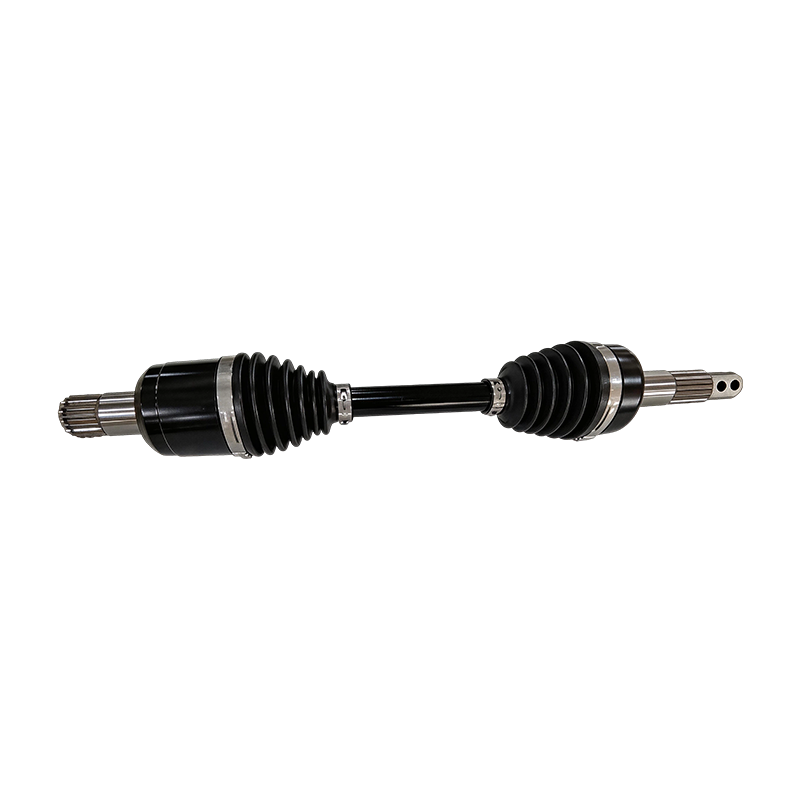
Constant Velocity (CV) joints solve the fundamental limitation of single U-joints: a standard U-joint creates a cyclic speed variation (the "cardan effect") when operating at angles above roughly 3°. CV joints—whether ball-and-groove (Rzeppa) or double-cardan (DC) style—deliver perfectly uniform output speed regardless of operating angle, eliminating the vibration associated with high-angle single U-joint setups.
In driveline applications, double-cardan CV joints are most common at the front of front-driveshaft assemblies on lifted trucks and 4WD vehicles. The joint consists of two U-joints connected by a centering socket and ball, which mathematically cancels the speed fluctuation produced by each individual joint. Operating angles up to 20–25° are achievable without vibration—a critical advantage after lift kit installation.
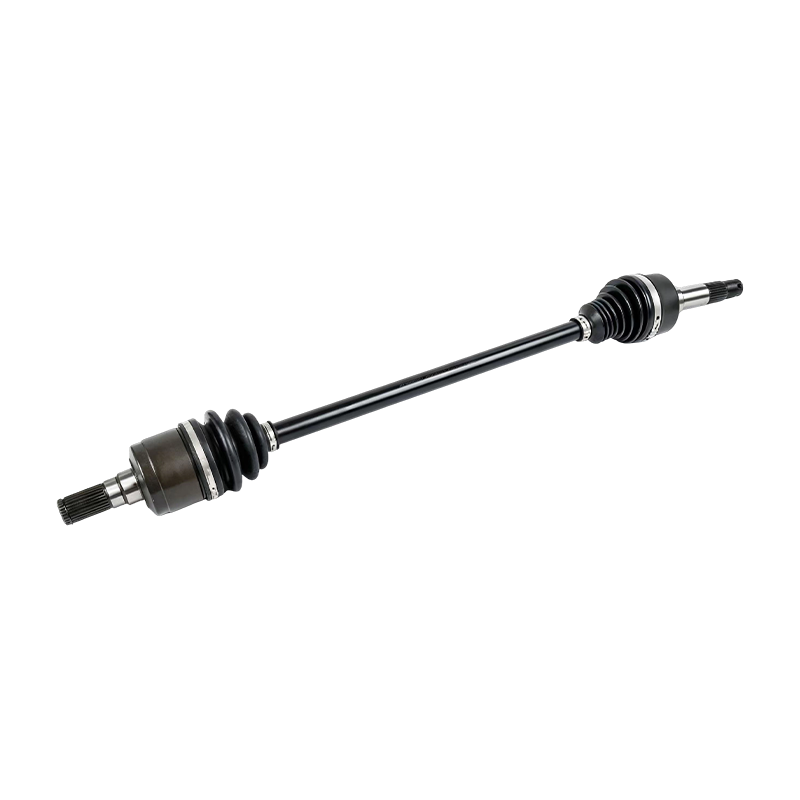
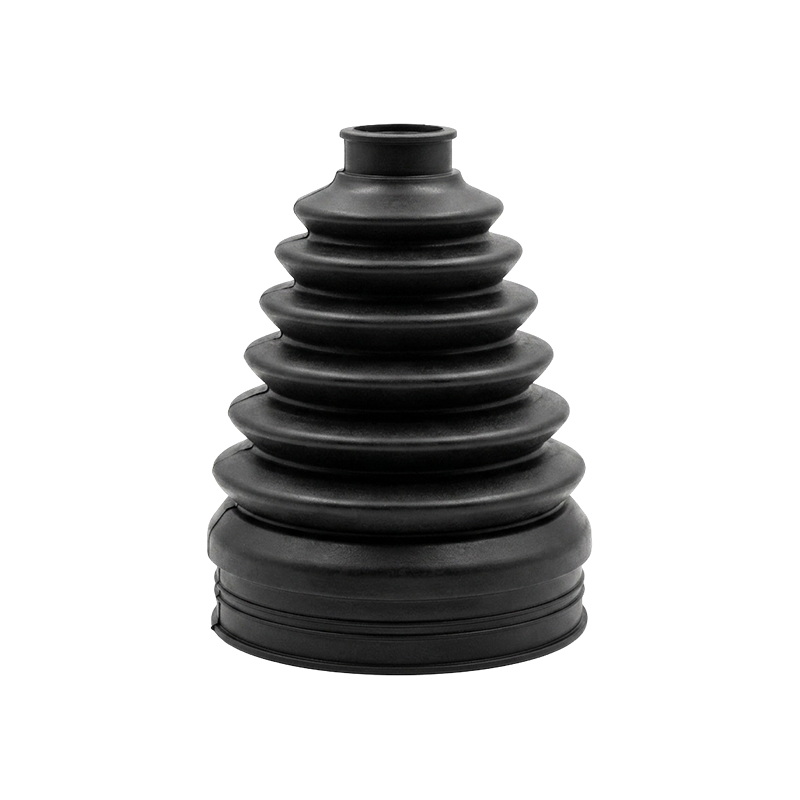
Front-wheel-drive vehicles use Rzeppa-style outboard CV joints on every axle shaft. These joints are enclosed in a rubber boot packed with special CV grease. A torn or cracked boot is the most common CV joint failure mode: once grease escapes and contaminants enter, joint wear accelerates rapidly. A boot replacement performed at the first sign of cracking typically costs a fraction of a complete axle replacement.
The table below summarizes every major part of a drive shaft assembly, its function within the overall driveline system, and the most common failure symptom to watch for:
| Component | Primary Function | Common Failure Symptom |
|---|---|---|
| Shaft Tube | Transmit torque along vehicle length | Vibration; visible dent or bow |
| Universal Joint | Allow angular misalignment between components | Clunk on acceleration; vibration at speed |
| Slip Yoke | Compensate for length change during suspension travel | Transmission leak; backlash clunk |
| Flange Yoke | Connect driveshaft to differential pinion | Loose bolts; vibration; axle seal leak |
| Center Support Bearing | Support mid-point of two-piece shaft | Rumble at 45–65 mph; worn rubber isolator |
| CV Joint (Double-Cardan) | Eliminate vibration at high driveline angles | Vibration when operating at lifted angles |
| CV Joint (Rzeppa) | Constant-velocity power delivery on FWD axles | Clicking during turning; torn boot |
Understanding how each part of a drive shaft works in sequence helps clarify why one failed component affects the entire system. Here is the torque path in a rear-wheel-drive vehicle:
Every link in this chain must be in good condition. A worn U-joint at step 3 creates torsional impulses that stress the slip yoke at step 2 and the flange yoke at step 5 simultaneously, compounding wear across multiple driveline components.
Not all replacement parts deliver equal durability. When sourcing driveline components for either routine maintenance or a performance build, prioritize these quality indicators:
A driveline part that fits by dimension but does not match the original U-joint series will operate outside its rated torque envelope. Always verify:
Autoparts CQC supplies a comprehensive range of driveline components—including U-joints, slip yokes, flange yokes, center support bearings, and CV joint assemblies—engineered to OEM dimensional specifications. Sourcing all related parts from a single supplier simplifies compatibility verification and ensures the entire driveline system works as a cohesive unit.
Proactive maintenance extends the life of every driveline component significantly. The following schedule applies to typical on-road passenger and light commercial vehicles:
| Component | Inspection Interval | Service Action |
|---|---|---|
| Greaseable U-joints | Every 5,000–10,000 miles | Grease with high-temp chassis grease until fresh grease purges from all four bearing cups |
| CV joint boots | Every 30,000 miles / at each oil change | Inspect visually for cracks, splits, or grease leakage; replace immediately if damaged |
| Center support bearing | Every 60,000 miles | Check rubber isolator for cracking and bearing for roughness; replace assembly if either shows wear |
| Slip yoke & splines | Every 30,000 miles | Inspect spline condition; lightly coat splines with moly grease during driveshaft removal |
| Flange yoke hardware | Every 30,000 miles | Verify torque on pinion flange nut and U-bolt or strap hardware; retorque to spec if any movement is detected |
Off-road, high-mileage commercial, or high-horsepower applications should halve these intervals. Grease that has blackened or contains metal particles indicates internal bearing damage—a component showing contaminated grease should be replaced, not simply re-greased.
1-949-870-6672
No. 169 Songpu Road, Cidong Industrial Zone, Cixi City, Ningbo City, Zhejiang Province, China
OEM/ODM Automotive Chassis Sealing Components Manufacturer
EV Drivetrain Components Supplier